Wednesday, March 24, 2010

Tarija

Tarija is a rather lovely department of Bolivia. The climate is nice, ideal for growing all year around: figs, grape vines, basil, fennel. Turn on the radio and an adorable child voice serenades the cows of Tarija.

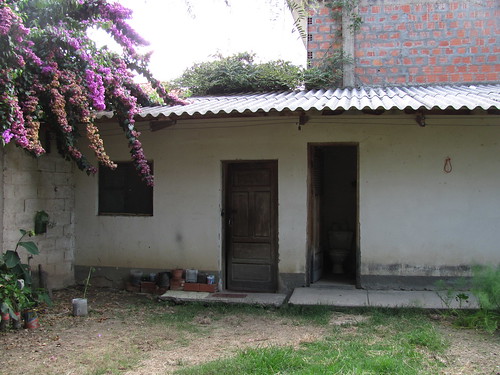
Our humble lodging at Mauricio´s place. Tarija, Bolivia

We´ve been working with Mauricio, who has been to France and Italy, where he worked as a wwoofer himself and studied food. He´s not much of a cook, but he prepares pesto, escabeche, smokey salt, eggplant salsa, limoncello, and various other artisan products. A quick learner, full of ideas; I hope he doesn´t lose his enthusiasm.

Already we taught him how to make bread, introduced him to hummus, and invented a few recipes like fig salsa for him to try out. First thing he asked us to do was tear up the dirt out front and make an example garden. We planted radish and lettuce. Mauricio knows he won´t get much out of this plot, but he is excited to be an advocate for the home garden and the organic technique.
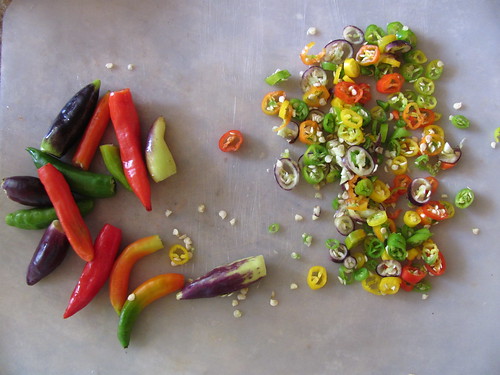
Our first day Courtney cut pepers for making salsa de aji. Very spicy.

We mentioned that we had written to an organic wine producer in the area; Mauricio was able to arrange a visit. It happened that he was giving a class that began 7 months prior, and was ending on what was the last day of summer here. He had hung up two pig legs in the wine cellar at the organic vineyard, Valle D´Vino, and invited us to come down for the cutting-of-the-ham. We biked through the rolling hills on a hot Saturday to meet him.

Pulling out the moldy legs of the chancho was fun. Every vegetarian has a bacon phase, so I had no hesitation about trying the two hams (ok, I´ve eaten enough meat in the last year that I can´t throw the word vegetarian around. So far in south america though, if you don´t have meat on your plate at any given moment, you´re assumed veggie.) It was tasty. Courtney didn´t try it, her willpower knows no end. Everyone she´s met has taken it upon themselves to try to convert her to carnivore, but she holds strong.
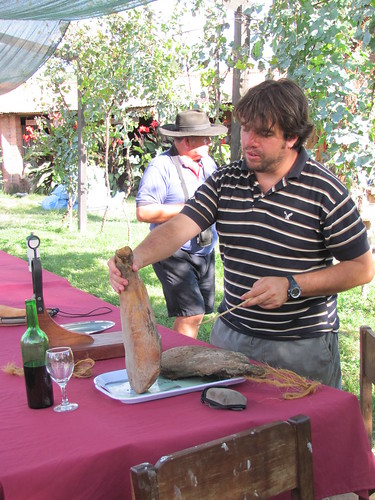
Mauricio shows us all about drying and testing dried meats, Valle de la Concepción, Bolivia

We stayed the night, bunking with a wwoofer from Arkansas on the vineyard. In the morning we woke up and chatted with the landholder, Don Jesus Romero, about the feria del queso. He agreed that we should go, and offered to take us there. First things first though. They brought a cow around and got the sugar, singani (grappa), and a few glasses. A spoonfull of sugar, a dash of singani, place your glass below the udder, stir: that´s ambrosilla, delicious, filling, and a genuine surprise that we´re not likely to forget.

Chris and the Cow! Valle de la Concepción, Bolivia

The feria del queso was fun, but better yet was the chance to be carried along by a landed gentleman who introduced us around and paid our way. He tried to show us the oldest church in Tarija, but they couldn´t find the key, so we had to make do with delicious cheeses. There isn´t much variety, but the cheese is miles beyond the poor excuses, deceptively labeled with recognizeable names that we found in Argentina, most of which turned out to be somewhere between colby and cream cheese, carrying varying amounts of salt. The festival promised to turn into a good revelry, as the Tarijeños drink plenty of wine and chicha, and they had a load of saddled horses and cows on hand, but we took off early so we could bike back to the city of Tarija in daylight.
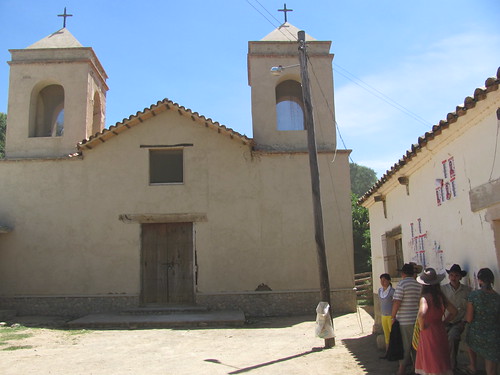
The oldest church in Tarija Provence, just outside the Feria de Queso, Juntas de Rosario, Bolivia

We took a bottle of organic cabernet for the road, as we have been abstaining (save a few drops of singani to cleanse the raw milk, and the touch of many wines to our lips for taste) as an experiment in purification. This and a bottle of quinoa beer that we´re still searching for could destroy us if we´re at 4,000 meters when we open them after 6 weeks without. Riding a bike through wine country is always rewarding. I especially like coasting at speed, watching vine rows perpendicular to the road pass by.
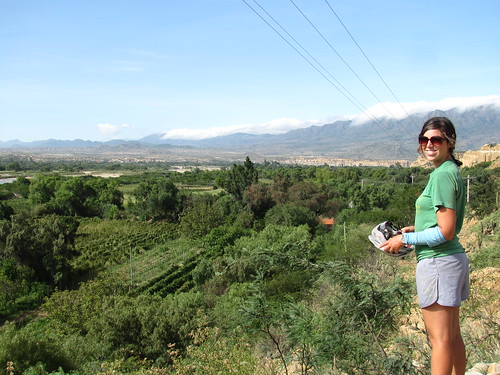
The ride back into Tarija through the Valle de la Concepción, Bolivia

While we haven´t actually had a ton of work, we´ve kept busy meeting people for dinner and tea, thanks to our amiable host. And as the elections are coming up, which are obligatory, politics keep coming up. I was at first excited to be learning something new, but it seems the same old story: government poorly managing funds; foreign or nationalized corporations taking all the natural resources and earnings; inequality and resentment between the indeginous ¨campesinos,¨and the whit(er) skinned folk. Well, we´ve been getting plenty of practice speaking spanish.

They say the internet is faster in La Paz, maybe we´ll be able to upload some more photos there. In the meantime, we´re getting nearer the Bolivian border at flickr.com/photos/jellofallacy


|


Wednesday, March 17, 2010

Bolivia!


So we crossed the boarder into Bolivia! We´ve been having stomach problems ever since! It´s been great. Actually it has been a mix of great and not so great. We arrived 10 days before we were supposed to be in Tarija due to a last minute change of plans so we figured we would use that time wisely and catch the train to Uyuni to see the famous Solar de Uyuni - the largest salt flat and the flattest place on earth. We are certainly wiser because of it, but it can´t really be called using our time wisely.


We first caught the train to Tupiza, which was beautiful in all directions. We hiked one day together just in the hills that break the town in half and Courtney took off for a hike through the canyons north of Tupiza the last day. We spent the time there in a Hostel which cost an amazing 7 dollars US for two for a bed and shower. Bolivia truely is cheaper than Argentina. By a lot! People were friendly enough but pushy when it comes to buying and selling. The gringo price is very real.


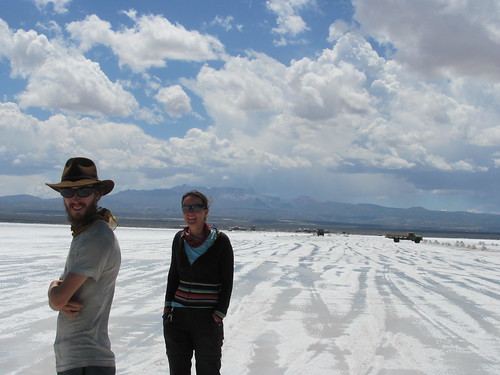
We only stayed for 2 nights because of our dream to see the salt flat and our limited time. The salt flat was TRUELY UNFORTUNATELY under water on all the edges making it very difficult to bike so we decided to leave our bikes in Tupiza and take the expensive but breathtaking (so everyone informed us) tour of the area. This includes lakes that change color with the wind, deserts at 5000 m above sea level, rocks that look like trees, flamingos and volcanos. The whole tour is 3 days in jeep. The landscape truely is breathtaking. There were too many highlights to catalogue. We colaborated with Paul and Coline and all shared a jeep through Juliet Tours. We felt pretty good about the whole thing the night before we left but things rapidly became clear.


The driver and his wife (the cook for the tour) hated us. Hated us. From the moment we met they were apethetic at best and on the final day they sat in the tour office and told us we were the worst kind of tourists because we didn´t buy tons of things we don´t need. They refused any offer to talk and specifically refused to learn our names by saying it was too hard even before the words were out of our mouths. They told us we were greedy for trying to get a good price on the tour. This was the information they had before getting in the car with us that made them decide that we were awful. The tour office promised many things that they didn´t mandate the tour guides to follow through on (and probably didn´t pay them enough to follow through on) such as water and a night in a hotel made of salt. So we spent 3 days with hate spilling out of the backs of the heads of our guides. Rather uncomfortable. They refused any offer to talk and specifically refused to learn our names by saying it was too hard even before the words were out of our mouths.


So we did learn something: the beautiful, not to be missed landscape that is more than challenging - life risking? - by bike, was also not worth the tour. Parts of the tour were breathtaking, but it was still a tour - 10 min here for pictures, back in the car, 10 min there fore pictures. We were too slow for the driver´s comfort, but they were too fast for ours. We had heaps of fun with Paul and Coline and took some great pictures, just like a good tourist should. But all in all, the bike tour would have shown us beautiful things in those 3 days that would have meant more to us in the end. Coline kept wondering aloud whether this spot or that was bikeable, and we worried for the safety of our bikes back in Tupiza and Courtney´s back began to ache due to the many hours of sitting in a car.

We also learned quite a bit about the mining projects beginning in the area. There is a whole town that has been relocated due to a Japanese interest in cutting down a mountain the people used to live in due to the silver inside. The school, hospital and some other services are free thanks to the money the silver brings in. The mines are employed by the Bolivians and run by the Japanese. There is also an interest in the Lithium in the salt flat. Enough Lithium for 10 generations, our guide says. But in 10 generations, there´s no salt flat, right? They are in negotiations to build a plant on the northern edge of the flat as we speak. A French electric car manufacturer is especially interested.

Bolivia is traditionally rich rich rich with minerals and natural resources, such as gas, but as a country, is poor. Other countries have the means to mine the resources and Bolivia is left with nothing to show for it.

Well after the tour was over we busted ass to get out of Uyuni the same night and spent the next day biking around Tupiza and camping in the beautiful, stunning, canyon filled, countryside. Our few hours after the tour and before the train we made a lovely goodbye dinner with Paul and Coline who we had been biking and traveling with for 2 weeks or so. We also saw a little more of the tourist trap that is Uyuni. The town would not exist if it weren´t for the salt flat. People have become bitter and money grubbing because of it. The tourist is there to take advantage of the Bolivian and visa versa. It´s an ugly scene all around.

So we spent another couple days in the area around Tupiza and then biked back to the city and took a bus to Tarija. Here we´re working with Mauricio on his small organic plot within the city limits and his artisan projects and getting to know the town. Hopefully we´ll get a chance to work with the other organic projects going on in the area. A winery, cabañas etc. Pictures to come.


Saturday, March 6, 2010

Mas Norte


We continued to travel north from Salta on Route 9. The road here was much less trafficked than the road north from Tucuman and much more beautiful. We wound our way up a few hundred meters the first day and camped at a lake for the evening. Courtney washed clothes and we both bathed in the shallow water before bed. The bottom of the lake was covered in grass and the water was warm. The temperature was quite a surprise considering we were ascending the Andes and had already reached about 1500m - we were thinking the lake would be cold glacier melt, like most mountain lakes in the US. There are no glaciers this far north, the lake was most likely engorged with rainwater, explaining the grassy bottom. Day 2 we cruzed down down down to Jujuy through beautiful mountain switchbacks, stopping around every third bend for another perfect photo opportunity.

After crossing the dams south of El Carmen we decided to look for a place to camp but despite the complete lack of traffic for 2 days of travel, cars came out of nowhere and we were suddenly in the suburbs of Jujuy. Land was fenced off, the cars were loud and a place to camp was no where to be found. We decided to bike into town and camp at the gas station but getting there was not easy. 3 highways converge right at the south end of Jujuy making our entrance rather tricky.

We made it to the YPF and camped. In the morning we ran errands and eventually biked out of town. The man at the hardware store where we bought feul said "Van por el norte? mucho subiendo y bajando" "going north? lots of up and down" We also met a pair of Belgians - Paul and Coline who are traveling in tandem in the same direction as us. We only made it 35 km for the day before reaching our 1000 mile mark for the trip (US portion included)!!! We were very excited, stopped, took a picture, biked one more mile and decided we were done for the day. Some days are better than others for distance. A normal day we´ll make at least 50 km.


From our campsite just outside of Jujuy at 1500m we climbed for 3 days up to the top of the pass and into the Altiplano just past Tres Cruces with an altitude of 3700m. As it turns out there´s a lot more subiendo than bajando. Almost no bajando actually. We had been climbing since Tucuman (300m altitude) but much more gradually.

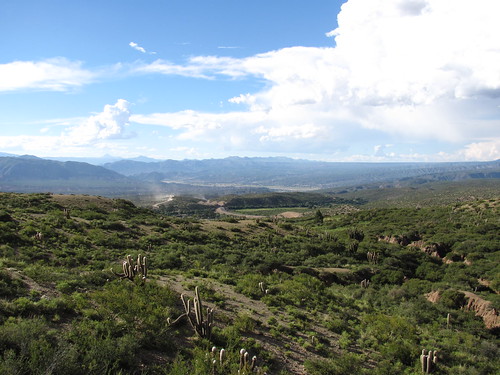
After lunch on the first day we were just starting to see the first signs of rain, and the wind was rushing us northward (better than trying to turn us around). We turned a corner, however, and were suddenly in the desert. The sky cleared, the hills turned into cliffs and the vegitation was suddenly prickily. Again, we stopped at every curve to take pictures.


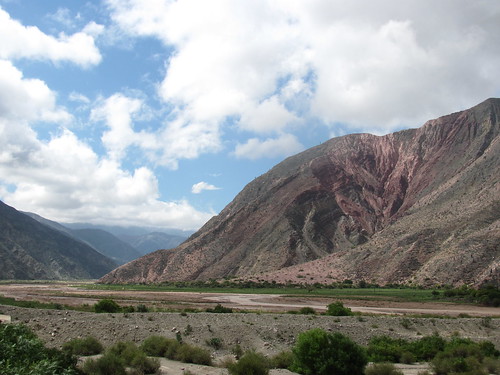
We got to make some fun touristy stops along the way. In Pumamarca we saw the cerro de siete colores which is a mountain side rich with layers of rock from different epochs dating back to when the Andes were in the ocean. This mountain scene was worth the 3 km we biked out of our way, but also not uncommon along the route. Everywhere we looked the mountains revealed beautiful juxtaposition of color and form. On our way out of town we ran into the Belgian couple just heading in to camp for the night.

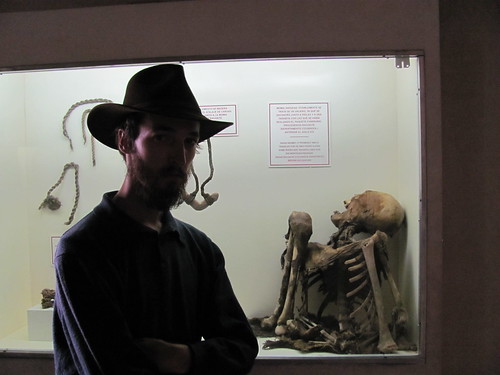
We camped outside of Posta de Hornillos - under a tree that seemed comfortable until we realized it too was covered in 2 inch pricks - so we could see the museum there first thing in the morning. The posta was one of many stops along a route from the silver and mineral mines in Bolivia and Peru on the way to Buenos Aires. Jujuy is one of the main hubs but the colonists had to try three times to create a station there. The indigenous groups resisted and destroyed the first 2. The museum showed a map of every battle fought between the indigenous people and the colonists. Between 1814 and 1824 (for the most part) the resistence was great but eventually, as we now can see, the colonists won out. The museum also showed a collection of archeological pots, tools, and even a mummy.


After Posta de Hornillos we wound our way up to Tilcara where we stopped to gather food supplies. The Municipal Market there is absolutely amazing. Beautiful vegetables and Courtney was even able to find a pair of socks for 2.5 pesos AR. Most of the larger towns along the route had mercados municipales. There is really no better way to shop. After lunch we made our way to Humahuaca where we stayed for the night. There we met up with the Begians once again. We camped together and have been crossing paths or riding together ever since.


North of Humahuaca we worked hard to accomplish our goal of Tres Cruces for the night. There is less oxygen after about 3000m so our last day was our hardest. We would also climb the 700m in one day as opposed to the 500m the previous two. We were also going farther than we had been. The road was steep and the wind was against us for the most part but the views were the most rewarding. We were still 20 km outside of Tres Cruces at 6:30pm. We had just decided we weren´t going to make it unless something spectacular happened when the wind died down and the road leveled out. We picked up speed and made the last 20 km in 1.5 hours. Paul and Coline were there waiting for us and making bets about when we would arrive.


From Tres Cruces we flew the next 80km to Pumahuasi. The Altiplano is just what it says it is. High and flat. We stopped in Abra Pampa for lunch - again there was a mercado municipal which treated us well. In the plaza we met up with Paul and Coline who noticed a US and Austrailian pair of cyclists coming from the north. They were helpful and friendly. We exchanged information about the southern routes for information about Bolivia. Only a few meters down the road we were landed upon by a group of touring cyclists from Columbia - traveling as 17 cyclists, all together - who told us that despite the fact that Uyuni is underwater, we had to go. So here we are in Tupiza, on our way.

La Quiaca is the Argentine border town. Together with Paul, Coline, we all road early in the morning to cross over to Bolivia. We split up because, being Belgian, they didn´t need to find a bank to pay the visa fee. We then proceeded to spend 3 hours in line crossing the boarder. If you make it here, you should know that they only accept US dollars, despite the fact that we are nowhere near the US. We had to change money 3 times and work through the beaurocracy. Then we rushed to the train station in Villazon - the Bolivian boarder town - and worked our way through another few lines to buy tickets, get our bikes unloaded and then pay for the luggage. We have been told by many many people that this particular section of road is the worst in all of Bolivia so the general concensus among bicyclists is to take the very affordable train ($3 US per person).

Here we are in Tupiza, a third of the way to Uyuni, a pit stop. We´re planning on hiking a bit and hoping that magically the salt flats will dry up and we will be able to bike them. As of now, however they´re under a meter of water. fingers crossed.


Wednesday, March 3, 2010

El Norte

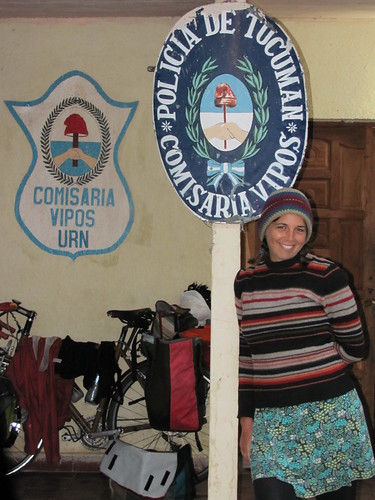
Leaving Tucuman we encountered cheap empanadas and heavy rains. 30 miles north things cleared up and we stayed with Sargentos Gomez y Lopez in the Comiseria de la policia in Vipos.

Sargento Gomez shared his thoughts on the world. He´d been in the army in the Islas Malvinas when he was young. Thanks to his sane life, drinking little and keeping his head up, he still looked young. He said that most people he sees are like animals, just eating and drinking bad wine. After so many dictatorships they look down on the police, and there is no army to speak of under the current government, so the British are in control of the Malvinas, or Falkland Islands as they call them, pursuing the mineral and oil reserves.


Well, he made a big salad for us and offered bread, soda, and beef fried in oil. Ahh, the sane life.

From there we found ourselves pedaling up a slow incline towards Salta. At Rosario de la Frontera, we met Juan, truck driver of 16 years. He carried us nearly 200KM into Salta, sharing stories of cargo he´s hauled (dynamite, sulfuric acid, and now soda and beer), travelers he´s picked up (teachers, crying boys, women who spontaneously undress, men who throw around all his CDs and have to be fought away), and the story of his brother who tried to take a job of his and will never speak to him again.

Arriving in Salta by truck, one sees billboards declaring that the city no longer tolerates ilegal vending. Travelling downtown by bicycle one sees ubiquitous vendors, on every street, selling every thing. As the police walk by in pairs, the vendors turn to look the other direction and the police pretend not to notice.


Standing in the peatonal (pedestrian street) trying on sunglasses from an ilegal vendor, the tiles of the street wobble a bit. We thought so anyway, until people began streaming out of a store nearby, as the alarm had been tripped, and the earth was moving. That´s what they call it, se move la tierra. We didn´t see any damage, and it was a few days before we heard about Chile and the hundreds of people who´ve died.


Cycling north from Salta, we found the most beautiful surroundings, including a narrow highway, well-paved but practically unused. Within days we bikes through lush semi-tropical forests, beautiful valleys, until we turned a corner north of Volcon, and found ourselves in the desert.

photos to come.


Tuesday, February 23, 2010

Uruguay to Tucuman

Our campsite at sunset. Outside Dolores, Uruguay

We rode half way to Mercedes and camped in a beautiful spot off the side of the road with the setting sun and tall grasses. We were eaten alive by ants but the mosquitos weren´t too bad.

It turned out that the warm up was a good idea. During Critical Mass in Buenos Aires, in our last few days there, we met a French couple living in BA for their daughter who wanted to learn Spanish. She had already learned French, English, and Chinese so Spanish was the next logical choice. They invited us over to a home made lasagna dinner and fantastically suggested that we ride to the next bridge in Fray Bentos instead of taking the ferry to Uruguay. We changed the idea but took it to heart. After 4 months of almost no bike riding, being dropped off at the foot of the Andes seemed a little daunting. So we did take the ferry but we biked north to the bridge in order to cross back. The bus from Rosario is over $100 US cheaper than the one from BA, and we didn´t have to pay for the ferry back.

Uruguay was beautiful, mostly flat with easy rolling hills. Farmland. Even so we were riding directly into the brutal, relentless wind and having small muscles to start, we averaged about 8 mph. Fortunately the people there are the friendliest people we´ve ever met. Always time for a chat, a tour, directions, offering help.

In Dolores, Roberto gave us a tour and invited us into his home for lunch - explained that he was poor for having 5 sons, but let us use 2 of his 3 computers with speedy internet and offered up his play station on one of his 2 TVs. We had run into him coming into town. He was waiting to pay his internet bill. We compaired prices of internet in the US and Uruguay. Still a little cheaper there.

In Mercedes Orlando helped us happily when we told him we lost our stove back at our campsite. He drove Chris back 15 km to look for it while Courtney waited with the bikes. When they returned he gleefully shouted out the window ¨NO ENCONTRAMOS!! NO ENCONTRAMOS!!¨ we didn´t find it. But he called Chris ¨Che¨ lovingly and we all got besos. Three 10 year old boys joined us in the plaza, played Courtney´s Ukulele until they broke a string, and sang us songs. They watched Chris make a new stove and all lined up for besos from Courtney and strong Norte Americano handshakes from Chris.

We were told that the Estancias of Uruguay were free to stay at and they give you food. So the night after we siesta´d in Mercedes, we went looking for an Estancia. We turned off the route onto a dirt road and biked for 6 miles into the hills and back out deciding that if there was an estancia down there, who knows how far it could be. We camped under the roof of a slightly abandoned house - well kept but empty. Good thing too, because the rain was incredible that night. The lightning was like a strobe light.

Our estancia. Outside Mercedes, Uruguay

Unfortunately Fray Bentos´s bridge has been closed in protest of the paper plant by the Argentinians for about 4 years. We talked with many Uruguayans about the conflict. There were troubles with tourism (people now having to drive 100 km north just to get home), troubles with cost of goods (it´s harder to transport goods over the boarder to Uruguay, raising the price), troubles with jobs (the commuters trying to get from Uruguay to there posts in Argentina lost their jobs. There are fewer positions available in Uruguay, something that after 4 years many people have not recovered from), not to mention the fact that the general relationship between Argentina and Uruguay has suffered. Argentina, as we now learned, has bitter relationships with Chile AND Uruguay.

The paper plant outside of Fray Bentos, Uruguay

Despite the closure, many Uruguayans suggested that we give the bridge a try. We are not Uruguayan and the closure is symbolic, so we may not have any trouble. It was worth the shot since the next bridge north was Paysandu: 100km farther north, into the wind.

We didn´t even get the chance to talk/bribe our way through the boarder. The Uruguayans stopped us first. No bikes on the bridge. But the bus to Paysandu was only $70 Uy and that´s about $3 US so we took our chances. To get the bikes on (despite the obvious amount of room) we had to argue, sweet talk, and eventually cry to get them on. The police and both drivers were ushured over. Driver no 1 said no, finally driver no 2 said, if they fit, why not? Yes, why not? So having fit bikes into much tighter spots, we were victorious and made it to Paysandu. We were not looking forward to our bus trip from Rosario to Tucuman. Turns out there´s an easier way.

The main avenue in Paysandu on Saturday Night, Argentina

As far as we were concerned, Paysandu was like Tokyo. The second largest city in Uruguay, (100,000 ppl) and lit up amazingly on Saturday Night. A vast difference when compaired with the other pueblos. We were showed the bootleg clothes and black market and directed to the free camping on the beach. ¨but it´s all underwater, so good luck¨ It was underwater. Several feet of water. But we camped up higher with the parrillas with no trouble.

In the morning we crossed the bridge without any problems at all and made it to Colon where we stocked up on supplies and headed south (winds at our backs). Argentina is building a second lane to make Route 14 a divided hwy but it´s not done yet. We had the pleasure of a whole 2 lane hwy to ourselves. Que fortuna. We made it to Caseros for the night when Courtney realized that she had left her wallet behind - we had just been to the bank so this was a huge blow. Thinking we were going to have to bike (possibly 25 miles) back to look for it, Courtney went to see if anyone could do anything to help. More than just anything, the employee of the gas station called the police and had them come to pick Courtney up. The police, for no reason at all, helped us. Courtney was driven to the last two rest spots (the second one was indeed 25 miles away) just to look for it, and THERE IT WAS! waiting for our return on the side of the new hwy. The color of dirt at this point so no one had spotted it. What luck. The police teased Courtney that her esposo wasn´t going to leave her now that she found it.

We left Caseros in high spirits but were lazy all day. We made it about 30 miles down the road, having stopped a few times (the wind had returned now that we were heading west) and eventually came to the realization that we needed to get to Tucuman to start the tour. Some how realizing this made it happen. After about 30 min of hitch hiking we were picked up by a family going to Rosario (a 3.5 hour drive away) who threw our bikes in the back of the truck and off we went. We were intertained by Juan, the youngest, and his stories about Wall-e and Lela´s (the older sister) love of Betty Boop. We made note of the fact that, if we had riden this distance, we would have been able to cross the bridge over the Parana river - there are paths on every bridge the whole 60 km between Victoria and Rosario. We also saw that those 60 km are completely flooded with water. El Niño has taken it´s toll here as well.

Our new friends who drove us all the way from Basavilbaso to Rosario, Argentina

We thought we would spend a day in Rosario but it was overwhelmingly cityish and so we just caught the 11pm bus out. The easier way to get the bikes on, bribe them. This made the cost of the bus no less cheaper than the ferry back to BA would have been, but no regrets.

Now we´re in Tucuman getting ready for ¨tour propper.¨ Today we head up the mountain dispite the pouring rain and thunderstorm the weather forcast has promised.


Thursday, February 18, 2010

Warm-up in Uruguay

We started the tour!

First day we rode our bikes and put them on the train to Tigre, suburb of BA. From there we took a 3 hour ferry to Carmelo, Uruguay. As it was getting dark soon, we took a quick tour of the city to see where we might camp for the night. About one block from the ferry and we were making our first friend, Poppy. Our new dog wouldn´t get his name until we woke up the next morning to find that he was still outside our tent, watching our bikes for us.

The night we arrived was the end of Carnival, so we went downtown to watch the parade of pretty ladies, boys in white masks dressed in drag, and Mozambique (sister city?) drummers, also in a bit of drag. Poppy was with us the whole time, barking whenever we started to get on the bikes. Anytime a car would pass us, he would bark at to make sure we were safe.

Poppy, tounge out.

Day 2, February 17th, we left Carmelo going northwest towards Nueva Palmira. As we left the city, surely Poppy would leave us behind. No, Poppy wouldn´t leave us until we left route 21 to enter Nueva Palmira, about 18 KM away. That dog was hard to deter and harder to wear out. It was a shame we couldn´t keep him, but 50+ KM per day is a lot to ask of a dog.
Roberto and Chris on the Rio San Salvador

Today we´re taking our siesta in Dolores. We made fast friends with Roberto, who gave us a quick tour on his bike. He told us about the cereal grain industry here, showed us the old Molino San Salvador (still running) along the beautiful and tranquil rio San Salvador, and the statue of Artigas, the Uruguayan liberator.
The Molina (mill) San Salvador

A cool shower was next, Roberto knew exactly what we needed. Over a nice lunch, our host told us about the Argentine picketers who have kept the international bridge from Fray Bentos to Argentina closed for years, in protest over a paper mill on the Uruguayan side. The battle seems lost as the paper mill has been running awhile now, and thanks to the protests and new technology is a relatively small issue as it pertains to contamination of the river. The soy crops, he says, are a huge polluter.

But now, on towards Mercedes.


Wednesday, February 3, 2010

The Why of it.

Chris and Courtney are trying to make it to Lima, Peru by May 1st. A series of crazy events including a broken arm have thus far kept us from fulfilling our dream bike tour in South America. We waited it out here in Argentina and have seen many beautiful things, BUT inflation is high, work is hard to find, and wages are low so in order to make it north to Peru we're asking for help.

While we are in South America our goals are to learn Spanish, Culture, History and Agriculture. Currently we are studying Spanish in and out of the classroom. We are reading and conversing about the history of Argentina and it's neighboring countries. We have traveled to the far reaches of Argentina - gaining a broad perspective of the language and land. We have already passed many hours conversing with locals and learning about their stance on life and politics. When we set out on this adventure, we were hoping to make it more than just a vacation and we have succeeded thus far.

We want to travel to Northern Argentina, through Bolivia, Chile and Peru. From here we hope to learn about the many differences and similarities in Culture, History, and even Language these countries have to offer. Along the way we're hoping to volunteer on small farms.

In order to Achieve this goal we will need a few thousand dollars for visas, day-to-day expenses, shipping our bikes home, Spanish Lessons, and entrance fees to Cultural Events and National Parks, etc.

This is a tall order, but anything helps and the rest is up to luck and hard work. So this is technically a blog about our bike trip to Peru. And will be once we start our tour. But for now we will entertain you with stories about our time away from home thus far.

So you know just what you are contributing towards, we've constructed a tiered budget to show a continuum of comfort and completion of the trip.

Making a minimalist trip that takes us through Bolivia to Peru, and home:

  • $200 - taking our bikes home on the plane
  • $270 - reciprocal entrance fee to Bolivia for U.S. citizens
  • $300 - bus and train rides through un-bikeable areas (the never-ending urbanity of Buenos Aires and deserts of Bolivia)
  • $510 - food budget of $30/week for 17 weeks
  • $300 - travel insurance

The minimalist trip costs us $1580. Doing the trip as we intend to, the budget goes up:

  • $510 - fresh foods and the occasional bed and shower, to keep us moving while we're biking the Bolivian altiplano at 13,000 feet; again, this is over 17 weeks.
  • $150 - Spanish Classes
  • $400 - non-bicycle-activity fees such as entrance to parks for hiking the Peruvian Andes, tour of Uyuni Salt Flat, and seeing Macchu Picchu.
  • $500 - preparation for the inevitable: inflation, broken equipment, unexpected costs.

Our total expected costs are $2540, and the cushion money puts our goal at just over $3000.

Please donate any amount to make our trip a reality. Short-term, interest-free loans are also welcome.

To learn more about us you can jump to the first post: Bike Tour Peru

Thank you so much for checking this out!