Saturday, March 6, 2010

Mas Norte


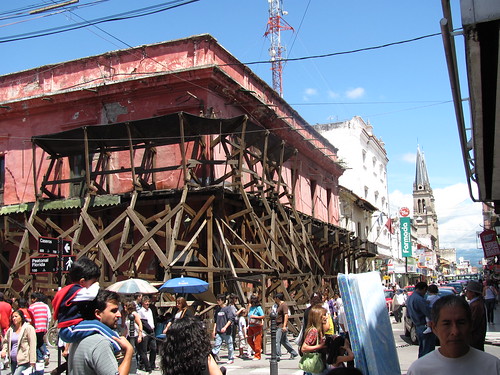
We continued to travel north from Salta on Route 9. The road here was much less trafficked than the road north from Tucuman and much more beautiful. We wound our way up a few hundred meters the first day and camped at a lake for the evening. Courtney washed clothes and we both bathed in the shallow water before bed. The bottom of the lake was covered in grass and the water was warm. The temperature was quite a surprise considering we were ascending the Andes and had already reached about 1500m - we were thinking the lake would be cold glacier melt, like most mountain lakes in the US. There are no glaciers this far north, the lake was most likely engorged with rainwater, explaining the grassy bottom. Day 2 we cruzed down down down to Jujuy through beautiful mountain switchbacks, stopping around every third bend for another perfect photo opportunity.

After crossing the dams south of El Carmen we decided to look for a place to camp but despite the complete lack of traffic for 2 days of travel, cars came out of nowhere and we were suddenly in the suburbs of Jujuy. Land was fenced off, the cars were loud and a place to camp was no where to be found. We decided to bike into town and camp at the gas station but getting there was not easy. 3 highways converge right at the south end of Jujuy making our entrance rather tricky.

We made it to the YPF and camped. In the morning we ran errands and eventually biked out of town. The man at the hardware store where we bought feul said "Van por el norte? mucho subiendo y bajando" "going north? lots of up and down" We also met a pair of Belgians - Paul and Coline who are traveling in tandem in the same direction as us. We only made it 35 km for the day before reaching our 1000 mile mark for the trip (US portion included)!!! We were very excited, stopped, took a picture, biked one more mile and decided we were done for the day. Some days are better than others for distance. A normal day we´ll make at least 50 km.


From our campsite just outside of Jujuy at 1500m we climbed for 3 days up to the top of the pass and into the Altiplano just past Tres Cruces with an altitude of 3700m. As it turns out there´s a lot more subiendo than bajando. Almost no bajando actually. We had been climbing since Tucuman (300m altitude) but much more gradually.

After lunch on the first day we were just starting to see the first signs of rain, and the wind was rushing us northward (better than trying to turn us around). We turned a corner, however, and were suddenly in the desert. The sky cleared, the hills turned into cliffs and the vegitation was suddenly prickily. Again, we stopped at every curve to take pictures.


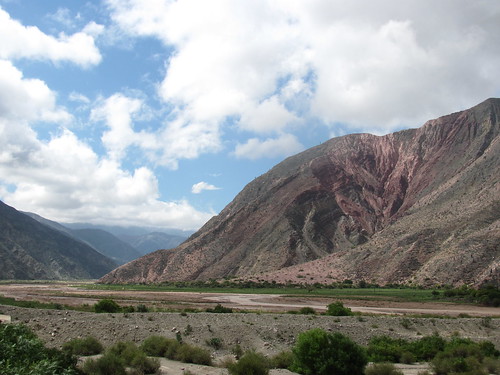
We got to make some fun touristy stops along the way. In Pumamarca we saw the cerro de siete colores which is a mountain side rich with layers of rock from different epochs dating back to when the Andes were in the ocean. This mountain scene was worth the 3 km we biked out of our way, but also not uncommon along the route. Everywhere we looked the mountains revealed beautiful juxtaposition of color and form. On our way out of town we ran into the Belgian couple just heading in to camp for the night.

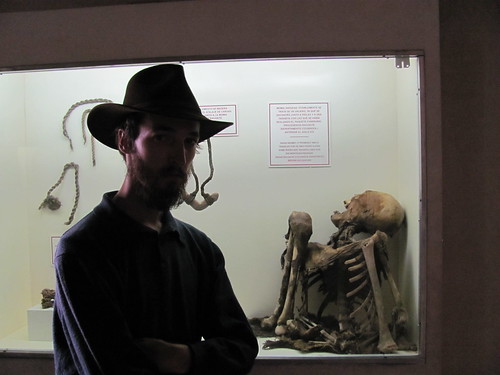
We camped outside of Posta de Hornillos - under a tree that seemed comfortable until we realized it too was covered in 2 inch pricks - so we could see the museum there first thing in the morning. The posta was one of many stops along a route from the silver and mineral mines in Bolivia and Peru on the way to Buenos Aires. Jujuy is one of the main hubs but the colonists had to try three times to create a station there. The indigenous groups resisted and destroyed the first 2. The museum showed a map of every battle fought between the indigenous people and the colonists. Between 1814 and 1824 (for the most part) the resistence was great but eventually, as we now can see, the colonists won out. The museum also showed a collection of archeological pots, tools, and even a mummy.


After Posta de Hornillos we wound our way up to Tilcara where we stopped to gather food supplies. The Municipal Market there is absolutely amazing. Beautiful vegetables and Courtney was even able to find a pair of socks for 2.5 pesos AR. Most of the larger towns along the route had mercados municipales. There is really no better way to shop. After lunch we made our way to Humahuaca where we stayed for the night. There we met up with the Begians once again. We camped together and have been crossing paths or riding together ever since.


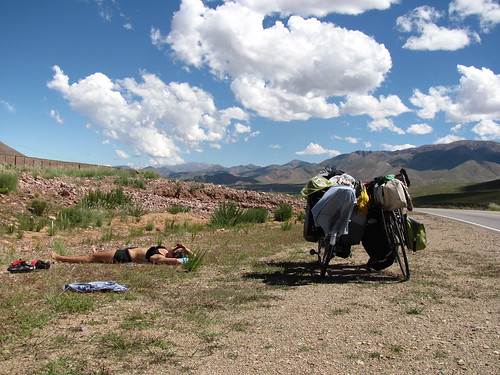
North of Humahuaca we worked hard to accomplish our goal of Tres Cruces for the night. There is less oxygen after about 3000m so our last day was our hardest. We would also climb the 700m in one day as opposed to the 500m the previous two. We were also going farther than we had been. The road was steep and the wind was against us for the most part but the views were the most rewarding. We were still 20 km outside of Tres Cruces at 6:30pm. We had just decided we weren´t going to make it unless something spectacular happened when the wind died down and the road leveled out. We picked up speed and made the last 20 km in 1.5 hours. Paul and Coline were there waiting for us and making bets about when we would arrive.


From Tres Cruces we flew the next 80km to Pumahuasi. The Altiplano is just what it says it is. High and flat. We stopped in Abra Pampa for lunch - again there was a mercado municipal which treated us well. In the plaza we met up with Paul and Coline who noticed a US and Austrailian pair of cyclists coming from the north. They were helpful and friendly. We exchanged information about the southern routes for information about Bolivia. Only a few meters down the road we were landed upon by a group of touring cyclists from Columbia - traveling as 17 cyclists, all together - who told us that despite the fact that Uyuni is underwater, we had to go. So here we are in Tupiza, on our way.

La Quiaca is the Argentine border town. Together with Paul, Coline, we all road early in the morning to cross over to Bolivia. We split up because, being Belgian, they didn´t need to find a bank to pay the visa fee. We then proceeded to spend 3 hours in line crossing the boarder. If you make it here, you should know that they only accept US dollars, despite the fact that we are nowhere near the US. We had to change money 3 times and work through the beaurocracy. Then we rushed to the train station in Villazon - the Bolivian boarder town - and worked our way through another few lines to buy tickets, get our bikes unloaded and then pay for the luggage. We have been told by many many people that this particular section of road is the worst in all of Bolivia so the general concensus among bicyclists is to take the very affordable train ($3 US per person).

Here we are in Tupiza, a third of the way to Uyuni, a pit stop. We´re planning on hiking a bit and hoping that magically the salt flats will dry up and we will be able to bike them. As of now, however they´re under a meter of water. fingers crossed.



Wednesday, March 3, 2010

El Norte

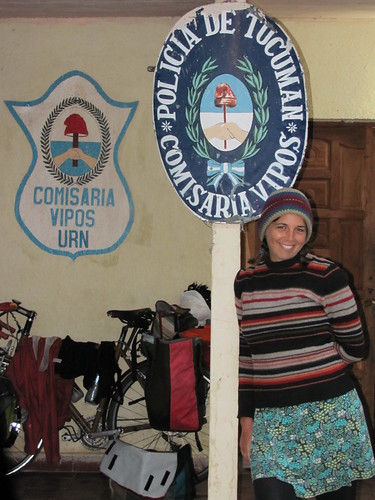
Leaving Tucuman we encountered cheap empanadas and heavy rains. 30 miles north things cleared up and we stayed with Sargentos Gomez y Lopez in the Comiseria de la policia in Vipos.

Sargento Gomez shared his thoughts on the world. He´d been in the army in the Islas Malvinas when he was young. Thanks to his sane life, drinking little and keeping his head up, he still looked young. He said that most people he sees are like animals, just eating and drinking bad wine. After so many dictatorships they look down on the police, and there is no army to speak of under the current government, so the British are in control of the Malvinas, or Falkland Islands as they call them, pursuing the mineral and oil reserves.


Well, he made a big salad for us and offered bread, soda, and beef fried in oil. Ahh, the sane life.

From there we found ourselves pedaling up a slow incline towards Salta. At Rosario de la Frontera, we met Juan, truck driver of 16 years. He carried us nearly 200KM into Salta, sharing stories of cargo he´s hauled (dynamite, sulfuric acid, and now soda and beer), travelers he´s picked up (teachers, crying boys, women who spontaneously undress, men who throw around all his CDs and have to be fought away), and the story of his brother who tried to take a job of his and will never speak to him again.

Arriving in Salta by truck, one sees billboards declaring that the city no longer tolerates ilegal vending. Travelling downtown by bicycle one sees ubiquitous vendors, on every street, selling every thing. As the police walk by in pairs, the vendors turn to look the other direction and the police pretend not to notice.


Standing in the peatonal (pedestrian street) trying on sunglasses from an ilegal vendor, the tiles of the street wobble a bit. We thought so anyway, until people began streaming out of a store nearby, as the alarm had been tripped, and the earth was moving. That´s what they call it, se move la tierra. We didn´t see any damage, and it was a few days before we heard about Chile and the hundreds of people who´ve died.


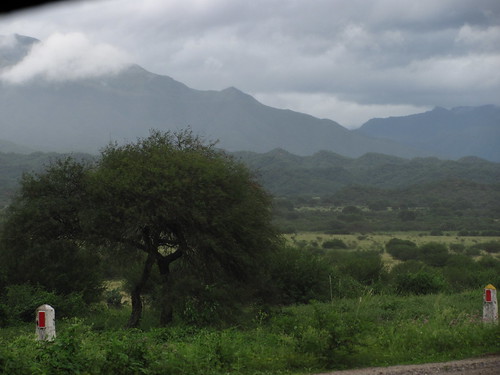
Cycling north from Salta, we found the most beautiful surroundings, including a narrow highway, well-paved but practically unused. Within days we bikes through lush semi-tropical forests, beautiful valleys, until we turned a corner north of Volcon, and found ourselves in the desert.

photos to come.


Tuesday, February 23, 2010

Uruguay to Tucuman

Our campsite at sunset. Outside Dolores, Uruguay

We rode half way to Mercedes and camped in a beautiful spot off the side of the road with the setting sun and tall grasses. We were eaten alive by ants but the mosquitos weren´t too bad.

It turned out that the warm up was a good idea. During Critical Mass in Buenos Aires, in our last few days there, we met a French couple living in BA for their daughter who wanted to learn Spanish. She had already learned French, English, and Chinese so Spanish was the next logical choice. They invited us over to a home made lasagna dinner and fantastically suggested that we ride to the next bridge in Fray Bentos instead of taking the ferry to Uruguay. We changed the idea but took it to heart. After 4 months of almost no bike riding, being dropped off at the foot of the Andes seemed a little daunting. So we did take the ferry but we biked north to the bridge in order to cross back. The bus from Rosario is over $100 US cheaper than the one from BA, and we didn´t have to pay for the ferry back.

Uruguay was beautiful, mostly flat with easy rolling hills. Farmland. Even so we were riding directly into the brutal, relentless wind and having small muscles to start, we averaged about 8 mph. Fortunately the people there are the friendliest people we´ve ever met. Always time for a chat, a tour, directions, offering help.

In Dolores, Roberto gave us a tour and invited us into his home for lunch - explained that he was poor for having 5 sons, but let us use 2 of his 3 computers with speedy internet and offered up his play station on one of his 2 TVs. We had run into him coming into town. He was waiting to pay his internet bill. We compaired prices of internet in the US and Uruguay. Still a little cheaper there.

In Mercedes Orlando helped us happily when we told him we lost our stove back at our campsite. He drove Chris back 15 km to look for it while Courtney waited with the bikes. When they returned he gleefully shouted out the window ¨NO ENCONTRAMOS!! NO ENCONTRAMOS!!¨ we didn´t find it. But he called Chris ¨Che¨ lovingly and we all got besos. Three 10 year old boys joined us in the plaza, played Courtney´s Ukulele until they broke a string, and sang us songs. They watched Chris make a new stove and all lined up for besos from Courtney and strong Norte Americano handshakes from Chris.

We were told that the Estancias of Uruguay were free to stay at and they give you food. So the night after we siesta´d in Mercedes, we went looking for an Estancia. We turned off the route onto a dirt road and biked for 6 miles into the hills and back out deciding that if there was an estancia down there, who knows how far it could be. We camped under the roof of a slightly abandoned house - well kept but empty. Good thing too, because the rain was incredible that night. The lightning was like a strobe light.

Our estancia. Outside Mercedes, Uruguay

Unfortunately Fray Bentos´s bridge has been closed in protest of the paper plant by the Argentinians for about 4 years. We talked with many Uruguayans about the conflict. There were troubles with tourism (people now having to drive 100 km north just to get home), troubles with cost of goods (it´s harder to transport goods over the boarder to Uruguay, raising the price), troubles with jobs (the commuters trying to get from Uruguay to there posts in Argentina lost their jobs. There are fewer positions available in Uruguay, something that after 4 years many people have not recovered from), not to mention the fact that the general relationship between Argentina and Uruguay has suffered. Argentina, as we now learned, has bitter relationships with Chile AND Uruguay.

The paper plant outside of Fray Bentos, Uruguay

Despite the closure, many Uruguayans suggested that we give the bridge a try. We are not Uruguayan and the closure is symbolic, so we may not have any trouble. It was worth the shot since the next bridge north was Paysandu: 100km farther north, into the wind.

We didn´t even get the chance to talk/bribe our way through the boarder. The Uruguayans stopped us first. No bikes on the bridge. But the bus to Paysandu was only $70 Uy and that´s about $3 US so we took our chances. To get the bikes on (despite the obvious amount of room) we had to argue, sweet talk, and eventually cry to get them on. The police and both drivers were ushured over. Driver no 1 said no, finally driver no 2 said, if they fit, why not? Yes, why not? So having fit bikes into much tighter spots, we were victorious and made it to Paysandu. We were not looking forward to our bus trip from Rosario to Tucuman. Turns out there´s an easier way.

The main avenue in Paysandu on Saturday Night, Argentina

As far as we were concerned, Paysandu was like Tokyo. The second largest city in Uruguay, (100,000 ppl) and lit up amazingly on Saturday Night. A vast difference when compaired with the other pueblos. We were showed the bootleg clothes and black market and directed to the free camping on the beach. ¨but it´s all underwater, so good luck¨ It was underwater. Several feet of water. But we camped up higher with the parrillas with no trouble.

In the morning we crossed the bridge without any problems at all and made it to Colon where we stocked up on supplies and headed south (winds at our backs). Argentina is building a second lane to make Route 14 a divided hwy but it´s not done yet. We had the pleasure of a whole 2 lane hwy to ourselves. Que fortuna. We made it to Caseros for the night when Courtney realized that she had left her wallet behind - we had just been to the bank so this was a huge blow. Thinking we were going to have to bike (possibly 25 miles) back to look for it, Courtney went to see if anyone could do anything to help. More than just anything, the employee of the gas station called the police and had them come to pick Courtney up. The police, for no reason at all, helped us. Courtney was driven to the last two rest spots (the second one was indeed 25 miles away) just to look for it, and THERE IT WAS! waiting for our return on the side of the new hwy. The color of dirt at this point so no one had spotted it. What luck. The police teased Courtney that her esposo wasn´t going to leave her now that she found it.

We left Caseros in high spirits but were lazy all day. We made it about 30 miles down the road, having stopped a few times (the wind had returned now that we were heading west) and eventually came to the realization that we needed to get to Tucuman to start the tour. Some how realizing this made it happen. After about 30 min of hitch hiking we were picked up by a family going to Rosario (a 3.5 hour drive away) who threw our bikes in the back of the truck and off we went. We were intertained by Juan, the youngest, and his stories about Wall-e and Lela´s (the older sister) love of Betty Boop. We made note of the fact that, if we had riden this distance, we would have been able to cross the bridge over the Parana river - there are paths on every bridge the whole 60 km between Victoria and Rosario. We also saw that those 60 km are completely flooded with water. El Niño has taken it´s toll here as well.

Our new friends who drove us all the way from Basavilbaso to Rosario, Argentina

We thought we would spend a day in Rosario but it was overwhelmingly cityish and so we just caught the 11pm bus out. The easier way to get the bikes on, bribe them. This made the cost of the bus no less cheaper than the ferry back to BA would have been, but no regrets.

Now we´re in Tucuman getting ready for ¨tour propper.¨ Today we head up the mountain dispite the pouring rain and thunderstorm the weather forcast has promised.


Thursday, February 18, 2010

Warm-up in Uruguay

We started the tour!

First day we rode our bikes and put them on the train to Tigre, suburb of BA. From there we took a 3 hour ferry to Carmelo, Uruguay. As it was getting dark soon, we took a quick tour of the city to see where we might camp for the night. About one block from the ferry and we were making our first friend, Poppy. Our new dog wouldn´t get his name until we woke up the next morning to find that he was still outside our tent, watching our bikes for us.

The night we arrived was the end of Carnival, so we went downtown to watch the parade of pretty ladies, boys in white masks dressed in drag, and Mozambique (sister city?) drummers, also in a bit of drag. Poppy was with us the whole time, barking whenever we started to get on the bikes. Anytime a car would pass us, he would bark at to make sure we were safe.

Poppy, tounge out.

Day 2, February 17th, we left Carmelo going northwest towards Nueva Palmira. As we left the city, surely Poppy would leave us behind. No, Poppy wouldn´t leave us until we left route 21 to enter Nueva Palmira, about 18 KM away. That dog was hard to deter and harder to wear out. It was a shame we couldn´t keep him, but 50+ KM per day is a lot to ask of a dog.
Roberto and Chris on the Rio San Salvador

Today we´re taking our siesta in Dolores. We made fast friends with Roberto, who gave us a quick tour on his bike. He told us about the cereal grain industry here, showed us the old Molino San Salvador (still running) along the beautiful and tranquil rio San Salvador, and the statue of Artigas, the Uruguayan liberator.
The Molina (mill) San Salvador

A cool shower was next, Roberto knew exactly what we needed. Over a nice lunch, our host told us about the Argentine picketers who have kept the international bridge from Fray Bentos to Argentina closed for years, in protest over a paper mill on the Uruguayan side. The battle seems lost as the paper mill has been running awhile now, and thanks to the protests and new technology is a relatively small issue as it pertains to contamination of the river. The soy crops, he says, are a huge polluter.

But now, on towards Mercedes.


Wednesday, February 3, 2010

The Why of it.

Chris and Courtney are trying to make it to Lima, Peru by May 1st. A series of crazy events including a broken arm have thus far kept us from fulfilling our dream bike tour in South America. We waited it out here in Argentina and have seen many beautiful things, BUT inflation is high, work is hard to find, and wages are low so in order to make it north to Peru we're asking for help.

While we are in South America our goals are to learn Spanish, Culture, History and Agriculture. Currently we are studying Spanish in and out of the classroom. We are reading and conversing about the history of Argentina and it's neighboring countries. We have traveled to the far reaches of Argentina - gaining a broad perspective of the language and land. We have already passed many hours conversing with locals and learning about their stance on life and politics. When we set out on this adventure, we were hoping to make it more than just a vacation and we have succeeded thus far.

We want to travel to Northern Argentina, through Bolivia, Chile and Peru. From here we hope to learn about the many differences and similarities in Culture, History, and even Language these countries have to offer. Along the way we're hoping to volunteer on small farms.

In order to Achieve this goal we will need a few thousand dollars for visas, day-to-day expenses, shipping our bikes home, Spanish Lessons, and entrance fees to Cultural Events and National Parks, etc.

This is a tall order, but anything helps and the rest is up to luck and hard work. So this is technically a blog about our bike trip to Peru. And will be once we start our tour. But for now we will entertain you with stories about our time away from home thus far.

So you know just what you are contributing towards, we've constructed a tiered budget to show a continuum of comfort and completion of the trip.

Making a minimalist trip that takes us through Bolivia to Peru, and home:

  • $200 - taking our bikes home on the plane
  • $270 - reciprocal entrance fee to Bolivia for U.S. citizens
  • $300 - bus and train rides through un-bikeable areas (the never-ending urbanity of Buenos Aires and deserts of Bolivia)
  • $510 - food budget of $30/week for 17 weeks
  • $300 - travel insurance

The minimalist trip costs us $1580. Doing the trip as we intend to, the budget goes up:

  • $510 - fresh foods and the occasional bed and shower, to keep us moving while we're biking the Bolivian altiplano at 13,000 feet; again, this is over 17 weeks.
  • $150 - Spanish Classes
  • $400 - non-bicycle-activity fees such as entrance to parks for hiking the Peruvian Andes, tour of Uyuni Salt Flat, and seeing Macchu Picchu.
  • $500 - preparation for the inevitable: inflation, broken equipment, unexpected costs.

Our total expected costs are $2540, and the cushion money puts our goal at just over $3000.

Please donate any amount to make our trip a reality. Short-term, interest-free loans are also welcome.

To learn more about us you can jump to the first post: Bike Tour Peru

Thank you so much for checking this out!

Chapter 9: Back to BA

So we made it back to our friend's house in Buenos Aires just one day before Christmas Eve and were able to get some money to buy a duck for Christmas dinner which we shared with Mike and Eliza, our friends here.

Courtney and Mike in front of Chrismas Dinner, Buenos Aires, AR

Shortly after we arrived, Andrew and Vicky showed up to go traveling with Mike and Eliza. After New Years Celebrations and Chris's Birthday Brunch all four of them headed off to the North and left us alone in the apartment for 6 weeks to walk the dogs and care for the apartment.

Chris in front of his birthday cupcakes, courtesy of Eliza. Buenos Aires, AR

Left to Right, Mike, Eliza, Andrew and Vickey leaving for their own adventure, Buenos Aires, AR

What is life like in BA? Do we get to call ourselves ex-pats or tourists? Well, life is surprisingly domestic. To keep within our food budget, we visit El Galpon - sort of like a farmer's market - twice a week for groceries. We've also discovered a similar cooperative just blocks from the house where we got a better idea of the organization of these healthy food markets. Rather than being organized around a central theme like organic or local, these markets support small farm movements in several fertile areas, thereby embodying the various ethics held by tomato farmers in Mendoza, Mate growers in Misiones, and of course local guertas - small plots producing the closest thing to organic available.

The bounty of El Galpón all for about $10 US, Buenos Aires, AR

Our day to day is spent rather calmly. We did the research and math about how long it takes to find a job, what the pay is, and how much we already have filling our days. After a few weeks of trying, we decided to call off the job search. Chris tends to stay below deck, stretching his fingers and retraining his hands to hold the violin with more precision while Courtney sunbathes on the terrace, attempting the unthinkable - she is reading, and finishing, Gravity's Rainbow.

Our Corner street art at Ravignani and Cabrera, Buenos Aires, AR

One good reason for our domestic lifestyle is our primary function here in Buenos Aires: to care for the dogs that Mike and Eliza had to leave behind. They have a dog walker but, like everyone else in Buenos Aires, he left for vacation. So our days are fairly organized around feeding, walking and exercising the pups - who have a lot of energy but need to stay in kennels every time you leave the house (lest they poop and pee and hyperventilate until you return. Strangely they seem to do just fine in the kennels in comparison). Needless to say, a long stay away from the house is hard for them.

Our charges: Inga and Emmy Lou. Plaza Mafalda, Buenos Aires, AR

When we leave the house, we study the Castellano language in the context of political questions surrounding guerillas, transportation, raw food, and worker cooperatives (having accidentally found a Spanish Teacher who loves all the same things we do). At night we attend free tango classes and various performances that the city government puts on in the plazas around the city.

Tango Aéreo in Parque Centenario, Buenos Aires, AR

We've also toured the city a little and now that Courtney is back on a bike, it's even easier to get around to see new things (naturally it has been raining ever since). We've thoroughly explored Palermo (the enormous neighborhood we live in) although there's probably many more secrets out there to see. Palermo spans across the northern part of the city along the river with the exception of Barrio Norte to the south and Belgrano to the north (neither of which are nearly the length of Palermo). It includes Palermo Soho, Palermo Viejo and Palermo Hollywood (we live in Hollywood). It's chalk full of cafes, plazas and parks. In fact a good third of the barrio is the Bosques de Palermo a park along the riverfront. We don't have money for cafes but it's quite nice to walk the dogs past all the people sitting outside them on the sidewalk under the shade of the trees drinking coffee, tea, wine, enjoying themselves. There's also Cementerio La Chacarita which is much lest touristy but equally as stunning as La Recoleta.

Family and geese under the Puente Blanco in El Rosedal - the Rose Gardens of the Bosques del Palermo. Buenos Aires, BA

We've been down south to San Telmo to see the flee market and the colonial architecture, and north to Barrio Norte to see the Cementerio La Recoleta where Eva Perón (Evita) was buried but we were turned away because of our bikes so we went to Floralis Genérica instead. We've been in the Microcentro to find camping equipment, see the masses, and view the famous Plaza de Mayo (the historical local for many a riot and revolution) and far North to Belgrano to see Barrio Chino (China Town) where they sell all the Asian and North American delicacies that are hard to come by in Buenos Aires (not without a decently sized price tag, however). Tomorrow with our Spanish teacher we're going to La Boca to talk to one of many worker-owned collectives in Buenos Aires and hopefully see some Tango.

Floralis Genérica at Plaza Naciones Unidas. Buenos Aires, AR

Chapter 8: Mendoza

Wine cellar at Familia Di Tommaso, Maipú, AR

We all got on a local bus to Mendoza City where they were preparing for their yearly holiday fiesta. There was drumming and a parade to the Plaza Independencia, live music and dancing. Instead of hassling the crowds in the plaza, the police were rescuing stray children which was adorable. Quite a welcome. We walked around the city watching the festivities, enjoying the warm night air - something non-existent in Patagonia - and made a summery green pepper, tomato, and squash soup for dinner.

Mendoza police officer rescuing a little boy, Mendoza, AR

We split up our time between the city of Mendoza and the surrounding vineyards. In Mendoza, in addition to the fiesta the night we arrived, we also spent a day walking around to all the satellite plazas that represent the different European backgrounds of the city and of course one for the hero of Argentina General San Martín. San Martín was born in Argentina but schooled in Europe where he also served in the military. When he learned that his home country was going through a revolution he quickly returned to help with the fight. His efforts proved to create miraculous results: training a military force and then charging over the pass between Mendoza and Chile (which even cars today don't attempt - the pass has been closed for years and a tunnel was built in its place) to defeat the colonial forces thus liberating Chile. He later helped with the forces in other countries, trying to help them break free of colonial rule but found his efforts were not quite as helpful and retreated back to Europe where spent the rest of his life. Mendoza also has an enormous park named for San Martín in which we spent a day wandering around.

The enormous monument to General San Martín perched at the top of Cerro Gloria. Mendoza, AR

Mendoza was also the place where, for the first time, everyone seemed to think that if we camped we would die. We got our wallet stolen and everything we did was just a little too touristy and organized - even though we didn't actually do any tours. Mendoza is the famous wine region of AR. They've been making wine here for about 500 years so it's pretty good. Unfortunately some things went wrong and we only got to taste at 2 places - Ironically one of these things was Chris having to bike for an hour to get to the bank to withdrawal the money that was going to be stolen that night.

However, the perk of going wine tasting is more about the beautiful landscape than the drink. We biked, Courtney mostly one handed, around through back roads with vineyards on all sides and pretty trees. It was hot and pleasant. Any time we tried to do something outside the normal wine route everyone was supposed to be on, someone would come up and tell us that we didn't want to or couldn't or shouldn't. So we did anyway and that was fine. Wine in the grocery store is really cheap also, so since we would have had to pay 25 pesos - 10 pesos more than most fairly good bottles - each just to taste 3 wines it turned out better to have spent most of our time biking around.

Chris trying the complementary wine at the Museo del Vino. Maipú, AR

We did end up at a (highly over priced) campsite where we met a group of French exchange students on vacation from school and a German couple. They invited us to eat their "Montón de Carne" with them and we all spoke Spanish since it was the only common language we had together. We spent two nights chatting it up until 4 in the morning over the parrilla - Argentine BBQ (only to get up at 7 am for touristy activities - We found out later that they were all 20, which explains why they had so much energy). In addition to new friends, our campsite had a pool! We were able to wake up to a good swim every morning.

The morning after the wallet was stolen, however, the police picked us up to file a report and let us use their phone to call anyone who might be able to help us out. As it turned out Juan's truck was still in disrepair and he had already headed home by bus to Buenos Aires so as not to miss Christmas festivities. The police dropped us off on the highway and after a few hours we met Abrio and Julio. They were driving a tanker truck full of concentrated Quilmes beer - the Argentine beer of choice - that was ice cold (the day, however was sweltering hot) and Julio let us try some beer with the lunch that he fed us. He felt sorry for us and was completely distressed that Courtney had never eaten carne before, so he bought us dinner (hoping that Courtney would eat steak). He took it upon himself to teach us Spanish and, the following afternoon, dropped us off at a bus stop with $50 AR for a bus into Retiro - the Main station in Buenos Aires - and a 6 litre water bag full of cerveza.

Our ride. The YPF outside of Mendoza, AR